
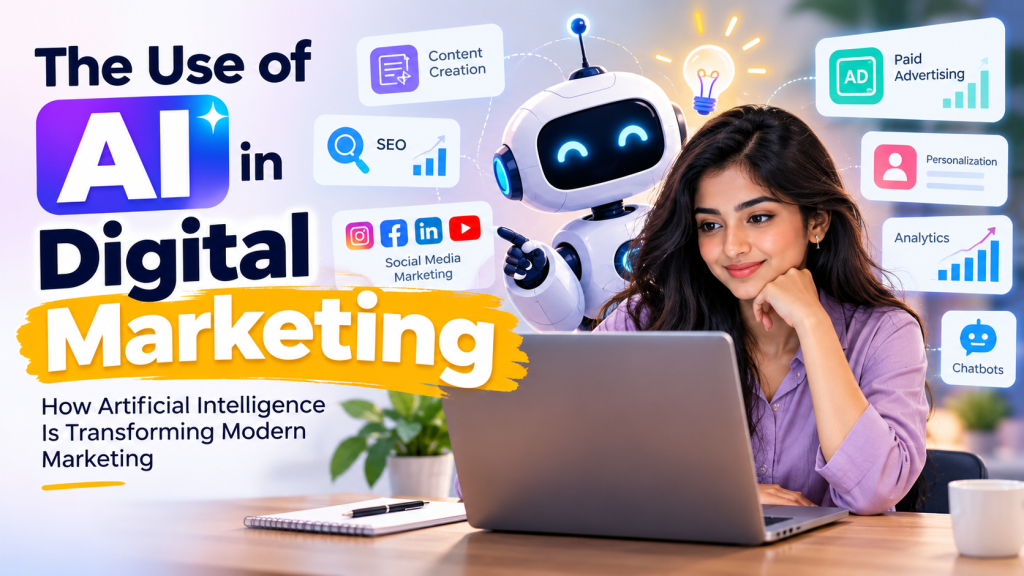
What Is AI in Digital Marketing?
AI in digital marketing refers to the use of artificial intelligence technologies to analyze data, identify patterns, automate marketing activities, predict customer behavior, and improve decision-making.
Traditional marketing often requires marketers to manually analyze large amounts of information and make decisions based on historical data. AI can process huge volumes of data much faster and identify patterns that may be difficult for humans to detect.
For example, an AI-powered marketing system can analyze:
- Customer behavior
- Website interactions
- Search queries
- Purchase history
- Social media engagement
- Ad performance
- Email interactions
- Customer preferences
This information can then be used to create more relevant campaigns and deliver better customer experiences.
Why Is AI Important in Digital Marketing?
Digital marketing generates enormous amounts of data every day. Businesses need to understand this data quickly to make effective marketing decisions.
This is where AI becomes valuable.
AI can help marketers:
- Automate repetitive tasks
- Analyze customer data
- Improve audience targeting
- Personalize customer experiences
- Generate content ideas
- Optimize advertising campaigns
- Predict customer behavior
- Improve customer support
- Identify marketing trends
- Measure campaign performance
The goal isn’t necessarily to replace marketers. Instead, AI can help marketers spend less time on repetitive work and more time on strategy, creativity, and decision-making.
AI-Powered Content Creation
One of the most popular applications of AI in digital marketing is content creation.
AI tools can help marketers generate:
- Blog ideas
- Social media captions
- Ad copy
- Email drafts
- Product descriptions
- Video scripts
- Content outlines
- Meta titles and descriptions
For example, instead of spending an hour brainstorming blog topics, a marketer can use AI to generate multiple ideas based on a specific audience and search intent.
However, AI-generated content should not simply be published without review.
Human marketers still need to add:
- Original insights
- Brand expertise
- Examples
- Accurate information
- Personal experiences
- A unique point of view
The best approach is AI-assisted content creation, rather than blindly publishing AI-generated content.
Personalized Marketing
Customers increasingly expect brands to provide experiences that are relevant to their interests.
AI makes large-scale personalization possible.
For example, an e-commerce business can use AI to analyze a customer’s browsing and purchasing behavior and recommend products that are more relevant to that customer.
You may have experienced this yourself when an online platform recommends:
“You may also like…”
or
“Recommended for you.”
These recommendations are often powered by algorithms that analyze user behavior.
AI can help businesses personalize:
- Product recommendations
- Email campaigns
- Website experiences
- Advertisements
- Offers
- Content
- Customer communication
Personalization can make marketing more relevant and potentially improve engagement and conversions.
AI in SEO
AI is also changing how marketers approach Search Engine Optimization (SEO).
AI can assist with tasks such as:
- Keyword research
- Search intent analysis
- Content topic research
- Content optimization
- Competitor analysis
- Internal linking suggestions
- SERP analysis
- Content gap identification
For example, instead of focusing only on a single keyword such as “digital marketing agency,” marketers can use AI to understand related topics and the different questions users may have around that subject.
However, SEO is not simply about inserting keywords into content.
Modern SEO requires marketers to understand:
Search intent + helpful content + topical relevance + user experience + authority.
AI can help with the research and analysis, but marketers still need to determine what information is genuinely useful to their audience.
AI is also changing how marketers approach Search Engine Optimization (SEO).
AI can assist with tasks such as:
- Keyword research
- Search intent analysis
- Content topic research
- Content optimization
- Competitor analysis
- Internal linking suggestions
- SERP analysis
- Content gap identification
For example, instead of focusing only on a single keyword such as “digital marketing agency,” marketers can use AI to understand related topics and the different questions users may have around that subject.
However, SEO is not simply about inserting keywords into content.
Modern SEO requires marketers to understand:
Search intent + helpful content + topical relevance + user experience + authority.
AI in Social Media Marketing
Managing social media requires continuous research, content creation, publishing, monitoring, and analysis.
AI can assist marketers throughout this process.
It can help with:
- Content ideas
- Caption generation
- Hashtag research
- Audience analysis
- Social listening
- Content scheduling
- Performance analysis
- Trend identification
AI can also analyze engagement patterns and help marketers understand which types of content are receiving better responses.
For example, if educational carousel posts consistently receive higher engagement than promotional posts, AI-powered analytics can help identify that pattern.
The marketer can then adjust the content strategy accordingly.
Email Marketing Automation

AI can make email marketing more personalized and efficient.
Instead of sending the same email to every subscriber, marketers can use AI to help determine:
- What content should be sent
- When an email should be sent
- Which subject line may perform better
- Which customers should receive specific offers
- Which subscribers are becoming inactive
For example, an online store could automatically send a personalized recommendation to a customer based on their previous interactions.
This can make email marketing more relevant and reduce the need for manual campaign management.
AI for Customer and Market Research
Understanding the target audience is one of the most important parts of marketing.
AI can analyze large amounts of information from sources such as:
- Customer reviews
- Surveys
- Social media conversations
- Search behavior
- Website interactions
- Competitor information
Marketers can use these insights to identify common customer problems, preferences, objections, and expectations.
For example, if hundreds of customer reviews repeatedly mention the same problem with a product, marketers can identify that issue and adjust their messaging accordingly.
AI therefore becomes a powerful research assistant.
Marketing Analytics and Reporting
Digital marketing produces numerous metrics, including:
- CTR
- CPC
- CPM
- CPA
- Conversion Rate
- ROAS
- Engagement Rate
- Customer Acquisition Cost
AI can help marketers analyze these metrics and identify patterns.
Instead of simply looking at a dashboard and seeing that conversions decreased, marketers can use AI-assisted analysis to investigate potential reasons.
For example:
Conversions ↓ → CPC ↑ → CTR ↓ → Creative fatigue may be a possible factor.
This doesn’t mean AI automatically knows the exact cause. Rather, it can help marketers identify patterns worth investigating.
Benefits of Using AI in Digital Marketing
When implemented correctly, AI can provide several benefits.
1. Saves Time
AI can automate repetitive tasks and allow marketers to focus on strategy.
2. Better Data Analysis
AI can process large amounts of data much faster than manual analysis.
3. Improved Personalization
Businesses can deliver more relevant experiences to different customer segments.
4. Faster Content Production
AI can accelerate brainstorming, drafting, and content development.
5. Better Decision-Making
AI-generated insights can help marketers make more informed decisions.
6. Improved Customer Experience
Chatbots, recommendations, and personalization can make customer interactions more convenient.
7. Scalable Marketing
AI can help businesses manage larger audiences and more complex campaigns without increasing manual work at the same rate.